
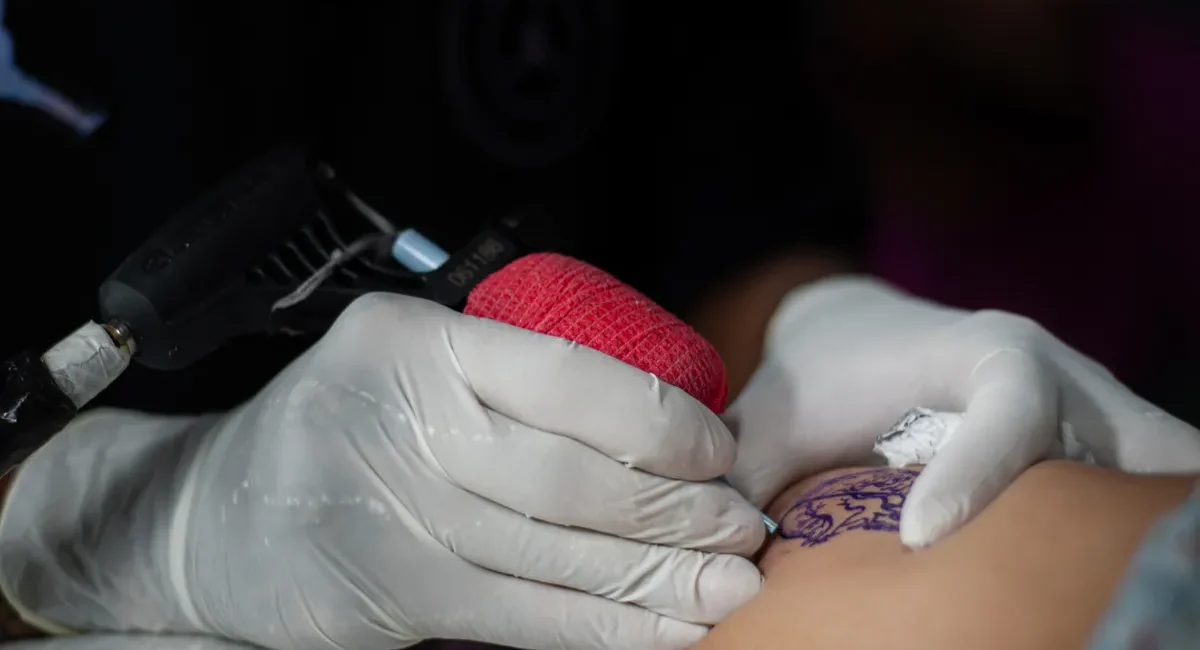
The gun tattoos cultural trend gathering momentum on Instagram is not reducible to any single political reading, and that is precisely what makes it worth attending to. A plaid-patterned M4 carbine stretched across a leg, a revolver cradled in lace, an AK-47 rendered in the flat lines of a self-taught hand: these images are proliferating across feeds and skin simultaneously, arriving at a moment when the firearm has never carried more contested symbolic weight.
From controller to skin: how gaming reshaped the gun’s visual register
For a generation that encountered guns first as in-game accessories, customisable in wild prints and camo patterns, available to cartoonishly wipe out opponents in Fortnite, Overwatch or Call of Duty, the weapon arrived pre-aestheticised. It was an object of play before it was an object of politics. That early conditioning is visible in many of the designs now appearing on skin: some are lifted directly from JRPGs, complete with system messages and anime-style figures; others are wrapped in lace, encoded in binary, or dropped into decorative patterns that would read as purely ornamental if the subject matter were different.
Sheffield-based tattoo artist Liv, who works under the handle @polka.pokes, describes one of her favourite commissions as ‘a custom design inspired by the quote “shot yourself in the foot” mixed with inspiration from my original plaid style tattoos.’ She has tattooed around six weapon designs so far, with more in the pipeline. The plaid gun, stretched across a client’s leg, sits comfortably in the same visual language as her other work. The subject is incidental; the style is the point.
This reframing of the weapon as aesthetic object has correlates elsewhere. In fashion, designers like Kai Ghattaura and the Parisian designer Rohan Mirza, whose shows Nuketown and Stonehaven draw directly from Call of Duty, have built entire runway languages around the collision of online and offline worlds. In music, artists including Slayyyter and EsDeeKid incorporate handguns into their visual rollouts; Snow Strippers sell the imagery at their merch stands. The gun is circulating through the same visual economy that produces any other tattoo trend.
Atlanta-based tattoo artist Gianna, who works as @meiintattoo, attributes part of the uptick to curation platforms like Pinterest, noting that she has seen ‘lots of gun tattoos recently.’ She draws a line of continuity with earlier weapon motifs: daggers, swords, and blades have cycled through tattoo culture for years, and the proliferation of medieval aesthetics over the last couple of years has made maces and longswords unremarkable. The difference with guns is temporal proximity. The historical distance that allows a sword to be separated from the violence it once inflicted does not yet exist for a firearm.
The politics of the gun tattoos cultural trend: self-defence, resistance, and a shifting subculture
Alongside the aesthetic dimension runs a political one, and it is more complicated than the obvious alignment with gun-rights conservatism. Research published in Nature – Humanities and Social Sciences Communications identifies a shift in American gun culture away from the recreational, sporting, and collecting subculture (described as Gun Culture 1.0) and towards a self-defence subculture (Gun Culture 2.0). That shift has not been uniform across political lines. Among some left-wing and marginalised communities, firearms have been reframed through ideas of resistance and community protection, visible in movements like Arm the Dolls and the emergence of left-wing shooting clubs.
It is worth noting how that self-defence framing sits against the available data. A 2024 survey by Rutgers School of Public Health, cited by Everytown Research & Policy, found that fewer than 1 per cent of respondents reported any form of defensive gun use in the past year. The same Everytown analysis notes that home invasions fell by more than 30 per cent between 2019 and 2023. The rhetoric of armed self-defence and the statistical reality it claims to address are, on these figures, significantly misaligned. What the data cannot fully account for is the symbolic work the gun is now being asked to do: it has become a sign of a particular stance, independent of its practical function.
Adam, a 26-year-old Atlanta-based tattooist who works under the handle @ineedarocketlauncher, describes his personal views as ‘staunchly anti-war and anti-fascist.’ His recent designs include Uzis, shotguns, revolvers, Glocks, AK-47s, RPG-7s, grenades, a minigun, and a tank. His most cherished is an AK-47 he tattooed on himself while learning the craft. ‘It looks quite shit but I like it for that reason too,’ he says. When his father saw it and objected not to the gun but to the specific model, asking why he had not chosen ‘something American like a M16 or AR-15,’ the reaction illustrated Adam’s point exactly. ‘The AK-47 is the most commonly used weapon for revolutions, insurgencies, civil wars and whatever else,’ he says. ‘I think a lot of people view it as a symbol of rebellion and returning power to the people.’ And then, with a candour that deflates any over-reading: ‘I also just like guns because they’re cool.’
That last admission is perhaps the most honest account of where the gun tattoos cultural trend currently sits. Politics, aesthetics, gaming nostalgia, and subcultural signalling are all present, sometimes in the same design. As the motif continues to migrate across feeds, merch tables, and skin, it may eventually settle into the same unremarkable category as the sword-wielding elf, its transgressive edge worn smooth by repetition. For now, though, the reactions Gianna describes, split between ‘people thinking they’re sick’ and others ‘wondering why someone would tattoo that on themselves,’ suggest the image retains enough friction to mean something, even if that something differs entirely depending on who is looking.