
Caleb Stein Down by the Hudson, published by Palo Gallery, is the kind of photobook that could only have been made by someone who fell in love twice in the same place: once with a person, and once with a patch of river.
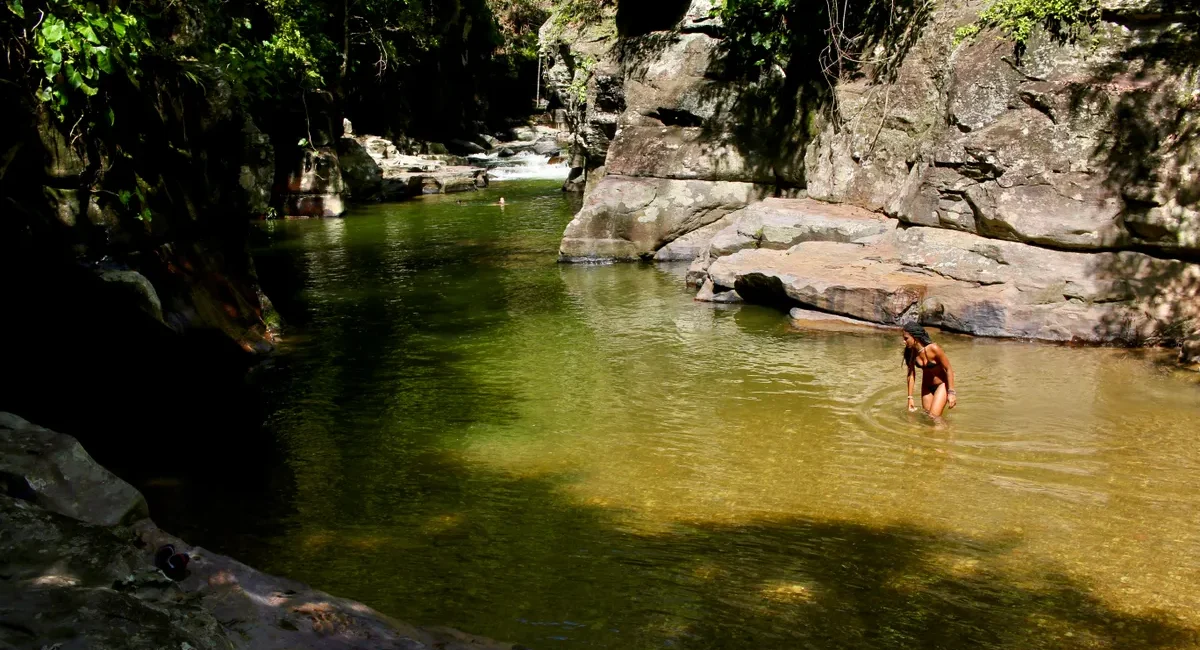
In 2013, Stein arrived in Poughkeepsie, New York, to study at Vassar College. He met Andrea Orejarena, a fellow student who remains his partner and close collaborator. She introduced him to a swimming spot along the Hudson River, tucked behind a drive-in movie theatre on the edge of town. He describes it to Dazed as an ‘edenic spot’: reached by ignoring warning signs, slipping through the woods, and wading out to a sandbank shaded by trees with a rope swing overhead. ‘It instantly became the place we’d spend all our free time,’ he says. He kept going back every summer for more than a decade.
What drew Stein was not only the landscape but the social texture that gathered around it. The spot was not exactly sanctioned, its approach marked by signs he compares to something out of Looney Tunes, and that air of mild transgression seemed to alter the atmosphere among those who arrived. ‘The Hudson Valley is filled with watering holes, but this one felt more like a secret,’ he says. ‘I saw people behave differently there because they’re kind of sharing that secret.’ The ‘joyfully illicit’ quality is baked into the book’s title and its mood: a place operating slightly outside the law tends to flatten the usual social hierarchies, at least for an afternoon.
His early documentary work in Poughkeepsie had been ‘episodic and unstructured’. The swimming site gave it a spine. Working digitally, he showed subjects images on the back of the camera and invited their collaboration, not everything produced was the result of a long-standing relationship, but, as he puts it, ‘none of the photographs were made without a conversation’. The result is portraiture of considerable tenderness. Young men appear not in postures of performance or swagger but in moments of float and drift. Vigour gives way to vulnerability. There is something in the specific quality of river light, and in Stein’s sustained attention, that makes the work feel less like documentation and more like devotion.
Caleb Stein Down by the Hudson and the politics of the watering hole
Stein is deliberate about situating the project within its political and economic context. Poughkeepsie was once a manufacturing hub shaped significantly by IBM, before the computer company downsized in the early 1990s, cutting thousands of jobs and leaving the town to absorb the consequences of deindustrialisation over the decades that followed. By 2016, when the project found its shape, local and presidential elections were so evenly divided, Stein says, that ‘you could have fit the difference into a bar on a Saturday night’.
The watering hole, in that context, becomes a kind of suspension. Undocumented people at risk of deportation and vocal Trump supporters swam from the same rope swing. ‘For a brief moment the political intensity and the very high-voltage feel of the US kind of dissipates, even if it’s just for an afternoon,’ he says. This is not presented as a naive resolution of real divisions; Stein is too careful a thinker for that. But he is interested in what shared physical experience can briefly do, in how water functions as a social solvent, and in the possibility of attending to ‘something that was actually working’ rather than cataloguing the familiar failures of post-industrial small-town America. ‘There has to be a hyper-focus on something if you’re suggesting an alternative,’ he adds.
The book’s material form extends the elemental theme. Printed on Danshi Snow paper, whose surface carries a faint ripple, the pages themselves seem to move. Shot entirely in black and white, the work is nonetheless saturated with the feeling of water, in the liquid glow of the tones, in the grain, in the way bodies dissolve at their edges into light. Stein, a swimmer since childhood who describes feeling ‘more comfortable in water than out of it’, understands immersion as both physical and psychological. ‘When you’re in water, you have to breathe differently,’ he reflects. ‘It’s a complete reset.’
The book is dedicated to Andrea Orejarena, to whom Stein is now married, and who was present at its origin. He calls it, without hesitation, a love letter: ‘Unapologetically, it’s a love letter.’ The spot itself may be harder to return to. The last time he visited, the police had closed it off following Fourth of July celebrations. Publishing the book has, in its own way, offered a form of release. ‘It’s like I can finally exhale,’ he says. ‘I can let it go, let it float down the river.’
Down by the Hudson is published by Palo Press, with an accompanying exhibition at Palo Gallery running from 10 September through 3 October 2026.