
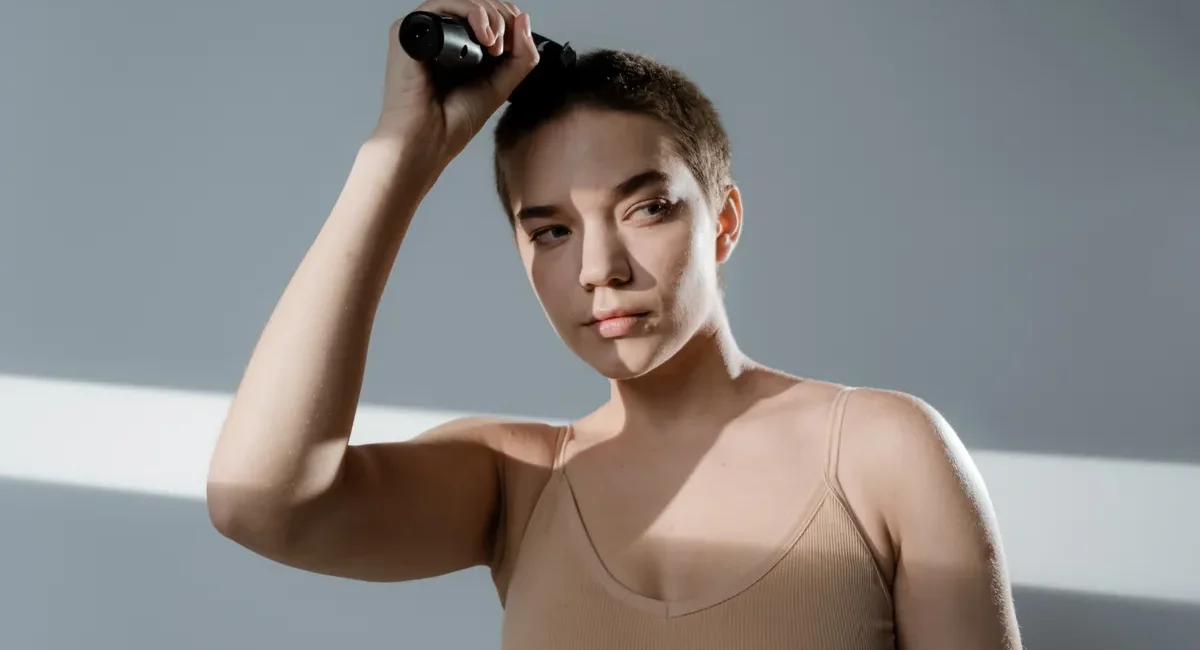
The bleached buzzcut cultural appeal is, on the surface, a fairly simple thing to clock: a man has removed most of his hair and turned what remains a pale, almost confrontational shade of yellow. And yet it keeps returning, keeps attracting, keeps provoking the kind of response that warrants a hungover Saturday morning conversation and, eventually, a longer piece of writing. It is a haircut that, somehow, carries a full personality inside it.
In 2022, the hashtag #bleachbuzzcut accumulated 15.6 billion TikTok views, a figure that suggests this is not a niche concern. The look has moved through culture in waves: David and Romeo Beckham, Zayn Malik, Justin Bieber, Moses Sumney, Seth Rogen, Carlos Alcaraz, Colin Farrell, Kylian Mbappé and Odell Beckham Jr have all experimented with it. More recently it has resurfaced through Connor Storrie’s new cut while filming Heated Rivalry season two, chops from Erling Haaland and Nettspend, and Vanity Fair’s selection of model and streamer Marlon Lundgren Garcia as its ‘Face’ in the September 2026 ‘State of American Style’ portfolio. The list is eclectic enough to suggest that the look transcends any single subculture or scene.
From Gaul warriors to Dennis Rodman: a short history of bleached hair
Rachael Gibson, who operates under the name ‘The Hair Historian’, traces the buzzcut’s roots to military and institutional contexts, where it functioned as a homogenising, functional cut, stripping individuality from the wearer rather than asserting it. Deliberate male hair-bleaching has a longer and stranger lineage still: among the Gauls, warriors bleached their hair with lime water to achieve a striking, intimidating appearance, a form of self-marking that was as much about projected power as it was about aesthetics.
By the 1970s, the buzzcut had migrated into skinhead and punk countercultures, where, Gibson explains to Dazed, it was ‘intentionally threatening and non-conformist’. The early 1990s marked a turning point. NBA star Dennis Rodman pushed the bleached buzzcut firmly into the mainstream, retaining its associations with rebellion while making it an expression of gender and sexual fluidity that became inseparable from his public persona. Gibson suggests his look may have been inspired by Wesley Snipes’ hair in the 1993 sci-fi film Demolition Man, as it ‘reflected a sense of futurism and was truly different to anything else being done’, though Rodman himself has disputed the origin story, calling the resemblance coincidental. Either way, the cultural signal was clear: bleaching a buzzcut was no longer simply about intimidation or subcultural belonging. It was about image, and the conscious construction of a self.
Momentum built through figures including Eminem and David Beckham as the style crossed from skate punk into the broader mainstream, arriving at the present moment wearing a surprisingly broad set of associations.
The bleached buzzcut as legible character claim
Hair colourist David Stanko, speaking to GQ in 2017, made the distinction clearly: ‘For women it’s a trend, but for guys it’s a bucket list or rite of passage look.’ That framing holds. The appeal of the bleached buzzcut, for the person wearing it, seems to begin with the act itself. As 23-year-old Oscar puts it, ‘they think the buzzcut is some scary thing, and it can be if you’ve maybe not got the best hairline, or if you’re a bit insecure.’ There is a courage in doing it anyway, and that courage reads.
For Meecham Whitson Meriweather, author of the Substack newsletter Now That I Mention It, the look is ‘less about the hair’ than about what it removes: ‘It’s pure confidence and beauty; it’s vulnerability: what you see is what you get.’ Bleaching compounds this further. As 22-year-old Ammara states, ‘the pop of blonde suggests [they’re] unafraid of being perceived. That’s hot.’
For many young women, part of the attraction lies in what the willingness to bleach communicates about a man’s relationship to femininity and convention. ‘I think a willingness to bleach your hair signals a certain level of comfortability with femininity which is attractive,’ says Joana, 23. Student Kaya frames it as a statement about masculinity itself: ‘It’s like the new masculinity is being masculine enough to be like, fuck it, I’ll engage with feminine behaviour.’ The bleached buzzcut, read this way, becomes a small but legible rejection of more rigid ideas about what men are supposed to look like.
Alex Brownsell, founder of Bleach London, offers the most precisely calibrated description of the look’s logic: ‘Bleach is to colour what buzzcuts are to length, a void defined by what isn’t rather than what is.’ The look achieves its effect through subtraction, not addition, which is exactly why it functions as a kind of permission slip. Graduate student Ella describes the persona it signals as ‘arty, intellectual’; 22-year-old Tom is blunter: ‘People think you’re cool without even speaking to you; it gives you license to be a bit crazier because people probably think you are.’
There is something between self-expression and self-curation happening here. The bleached buzz is heavily linked, as Gibson notes, to ‘bad boys who are in total control of their image, DGAF about expectations, and are totally happy to do something different’. And yet its appeal for the women who find it attractive seems ultimately tied to something warmer than that: a cluster of green flags, as the thinking goes (artistry, empathy, originality) written briefly across the top of someone’s head. The haircut of a man who might, it is imagined, treat you well. Whether the hair and the character always arrive together is, of course, a separate question entirely.