The night that made the FKA twigs Seoul rave worth a transatlantic flight did not announce itself in advance. It arrived, as the best nights tend to, sideways: Seoul Community Radio‘s tenth anniversary event at the spaceship-like Dongdaemun Design Plaza on 11 August drew together headliner FKA twigs, K-pop duo V8 (The8 and Vernon of Seventeen), rising Seoul artists The Deep and Yves, and German-born producer Mechatok for what turned out to be a collision of scenes that nobody present had quite prepared for.
When V8 rushed the stage at the FKA twigs Seoul rave
The moment everyone will be discussing arrived mid-set. Mechatok was deep into his hyperpop programme when he teased the opening beats of ‘singasong’, his collaboration with V8. The8 and Vernon rushed the stage unannounced, every smartphone in the room lit up simultaneously, and then, gliding into view from the side, twigs herself arrived at the dance pole. The sequence lasted perhaps three minutes. Its implications have been unspooling ever since.
V8’s appearance was unscheduled and, strictly speaking, improbable. The8 and Vernon are members of award-winning boy-band Seventeen, the kind of group whose movements are ordinarily managed with a precision that makes spontaneous club appearances difficult to imagine. That they chose this event, on this night, says something about where the cultural gravity is shifting in Seoul right now.
The event itself was one of three tenth-anniversary celebrations for Seoul Community Radio, the station-and-club-movement that SCR founder Rich has spent a decade building into one of the city’s most important incubators for underground dance music. Rich, speaking the week before, framed what his platform had nurtured in terms any British reader of a certain age would understand immediately. ‘It’s like what grime was to garage,’ he said of the new generation of Korean artists, among them The Deep, Yves, Effie and kimj, who are repackaging the flashy excess of mainstream K-pop in something rawer, less polished, more DIY.
The underground logic behind Seoul’s new maximalism
The comparison is apt, and not only as rhetoric. What grime did to UK garage was less a stylistic refinement than a social one: it relocated the music, changed who it spoke for, and in doing so changed what it was allowed to say. Something analogous appears to be happening in Seoul. The Deep and Yves, who performed earlier in the evening, represent a growing Korean subcurrent characterised by maximalist sonics and a deliberate railing against the restrictions that major-label K-pop imposes on its talent. Their contemporaries include kimj, whose production fingerprints appear, pointedly, on V8’s own recent work.
That last detail matters. V8’s collaborative project with Mechatok name-checks the producer in its chorus (‘I feel like Mechatok,’ the duo croon), a gesture that nods to the Drain Gang-affiliated producer’s status as a ubiquitous presence across forward-thinking electronic scenes internationally. The track is a piece of scene diplomacy as much as a song: K-pop’s biggest names signalling fluency in an underground language they once kept at arm’s length.
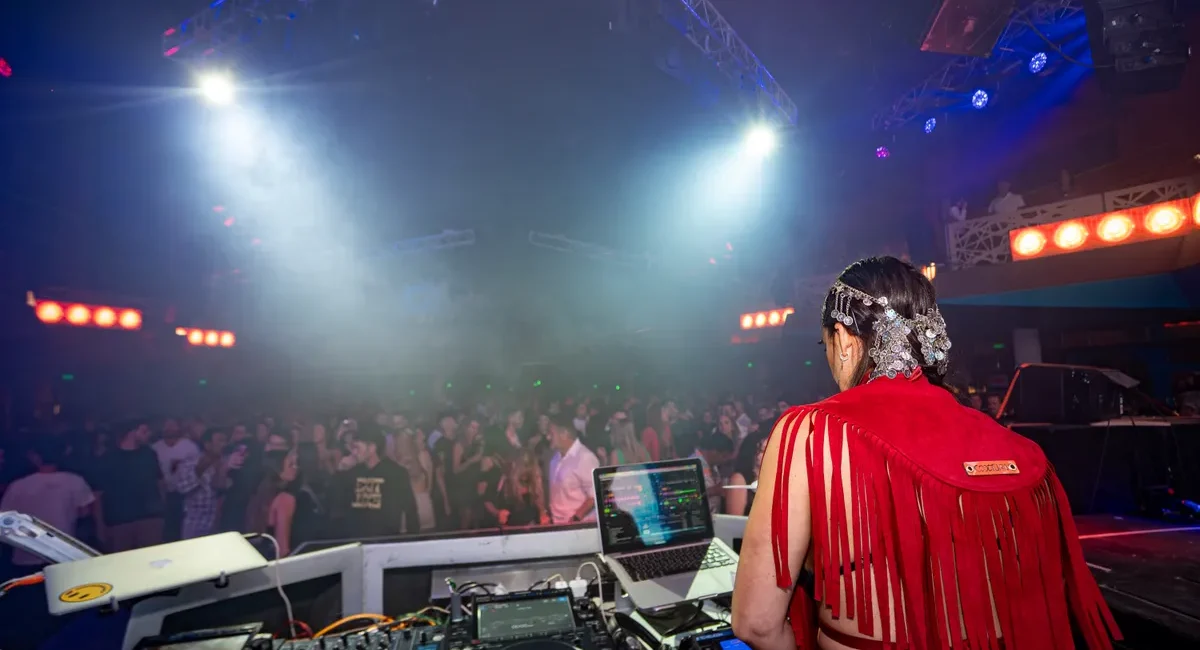
On the dancefloor, the results of this convergence were visible in real time. K-pop-style glow sticks pulsed to Skepta’s ‘Shutdown’ during cult Madrid DJs Josef and Diego Armando’s set. All-black-clad techno devotees of twigs’ Eusexua era vogued to a donk remix of ‘It Ain’t Safe’. Two South Korean ravers performed the tectonic dance during Mechatok’s set, apparently without irony or, more impressively, without self-consciousness. The evening’s sonic range was the point. SCR has spent ten years arguing that dance music is a single, wide-ranging text, and here was that argument made flesh.
In the impromptu smoking area (a cordoned-off bin beside a main road), a South Korean raver named Ha-joon offered his own diagnosis. ‘It’s like the counter-culture,’ he said. ‘People got bored of K-pop so this is the new thing. No K-pop artist would ever play here.’ Within the hour, two of K-pop’s most recognisable faces had done exactly that. Ha-joon’s observation was not disproved by this: it was confirmed by it. V8’s cameo underlined the underground’s cultural authority rather than undermining it. The mainstream, as ever, arrives late and calls it a collaboration.
Twigs closes the night, and christens a movement
FKA twigs, headlining at Dongdaemun Design Plaza, had other things to negotiate. An unexpected sore throat had limited her singing through much of the night, though few in the room appeared to notice or care. What she managed in its place was a different kind of performance: a collective, chaotic curtain call in which she pulled every artist who had performed that night onto the stage, one by one. Yves and Vernon were there, The8 and The Deep, event staff who had drifted onto the strip-pole, and eventually members of the crowd itself, K-pop stans alongside twigs’ techno devotees alongside Ha-joon, all mobbing the stage together.
The gesture had more cultural weight than a polished vocal set might have done. Knowingly or not, twigs had performed an act of scene-making: putting on stage, simultaneously and in full view of each other, the various communities that SCR’s decade of programming had been quietly trying to connect. The K-pop underground now has a christening night. The guest list, it turns out, was open to everyone.