The last time a total solar eclipse blotted out the Icelandic sky was 1954. On 12 August, Björk’s eclipse rave in Iceland made the wait feel, depending on your position in the crowd, either cosmically ordained or very well-timed PR. According to Vogue, this was the first total solar eclipse visible from the country in over seven decades, which goes some way to explaining why attendees had travelled from Hawaii and Japan to stand in a rocky Icelandic field at a rave called Echolalia.
Víðistaðatún, Hafnarfjörður: the venue that earned its moment
The event was held at Víðistaðatún sculpture park in Hafnarfjörður, on the outskirts of Reykjavik, and kept 7,000 people dancing, according to Pitchfork. The setting mattered. Iceland’s volcanic topography has a way of making the sky feel closer and more consequential than it does elsewhere, and the sculptor’s park, surrounded by the kind of picturesque rocky fields that resist any easy sense of occasion, provided precisely the right backdrop for an event designed to collapse the distance between terrestrial and celestial. DJ sets came from Arca, Ronja and Sideproject before Björk herself took the decks.
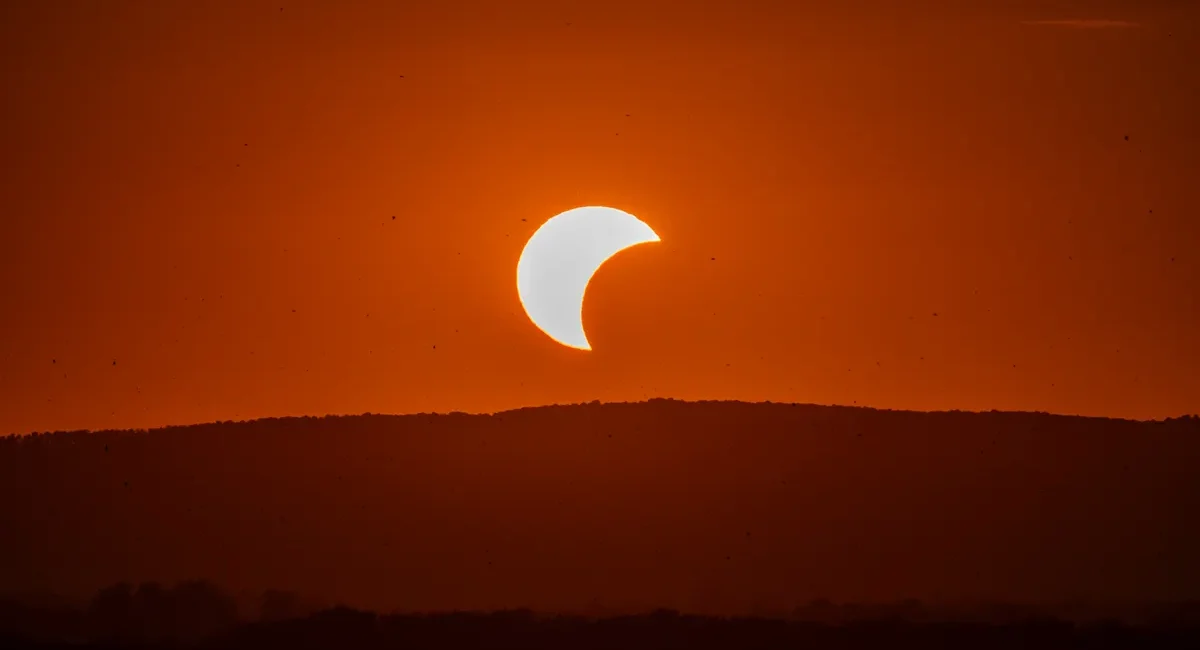
The music stopped for roughly seven minutes as the moon covered the sun. In the silence that wasn’t quite silence, the audience began chanting “Free, free Palestine.” Someone proposed to their partner. Then the light came back.
The dress as cosmological argument
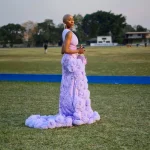
Björk’s entrance, timed to that return of light, was not underplayed. She emerged in a white balloon ensemble designed by Robert Wun, the Hong Kong-born designer, and the garment carried its own backstory: Vogue reports that the look was adapted from Wun’s fall 2026 collection, which had been shown in Paris only weeks earlier. The connection between a Paris runway and a lava-field rave in the sub-Arctic is the kind of leap that only really makes sense in the context of an artist who has spent three decades treating the boundary between the natural world and the invented one as largely advisory. For more on the design, Robert Wun‘s own archive shows the structural vocabulary the dress belongs to.
The opening track was the dramatic orchestral passage from Stanley Kubrick’s 2001: A Space Odyssey, which, given the circumstances, was less a choice than an inevitability. She closed with a remix of Rosalía’s “Berghain,” a track she features on: the arch European club reference slotted in, characteristically, alongside the solar mythology.
Björk eclipse rave Iceland: what the crowd actually saw
The Icelandic artist did not address the crowd in words. She communicated, as the photographer Alex Atherton recorded it, through movement: dancing erratically between songs, drumming chaotically on the DJ decks, a glass of rosé in hand throughout. The register was less performance than ritual, or at least the rave equivalent of one.
“Of course, the eclipse plunging the area into total darkness was a highlight,” Atherton said. “The setting, in the rocky picturesque Icelandic fields, combined with the experimental music and the rave descending into darkness, certainly made this totally unique.”
There is a version of this story that writes itself as celebrity spectacle, and another that writes itself as ecological theatre, and both of those readings sit a little uneasily with what Echolalia actually appears to have been: a large outdoor rave, in an unusually dramatic landscape, timed to a celestial event that Iceland had not seen since the mid-twentieth century. The chanting, the proposal, the Kubrick overture, the rosé: none of it was incidental. It was all part of the seven minutes of darkness that the crowd had, in some cases, crossed an ocean to reach.
The Björk eclipse rave in Iceland came at a moment when the practice of gathering around natural phenomena, from meteor showers to aurora events, is drawing the kind of mixed, multi-generational crowds, spanning ages from children to older adults, that the cultural calendar rarely produces otherwise. That 7,000 people organised themselves around a moment of astronomical predictability, and then filled it with music, politics, and at least one marriage proposal, suggests that what they were actually after was not the eclipse itself, but permission to treat the world as if it were still capable of surprise.