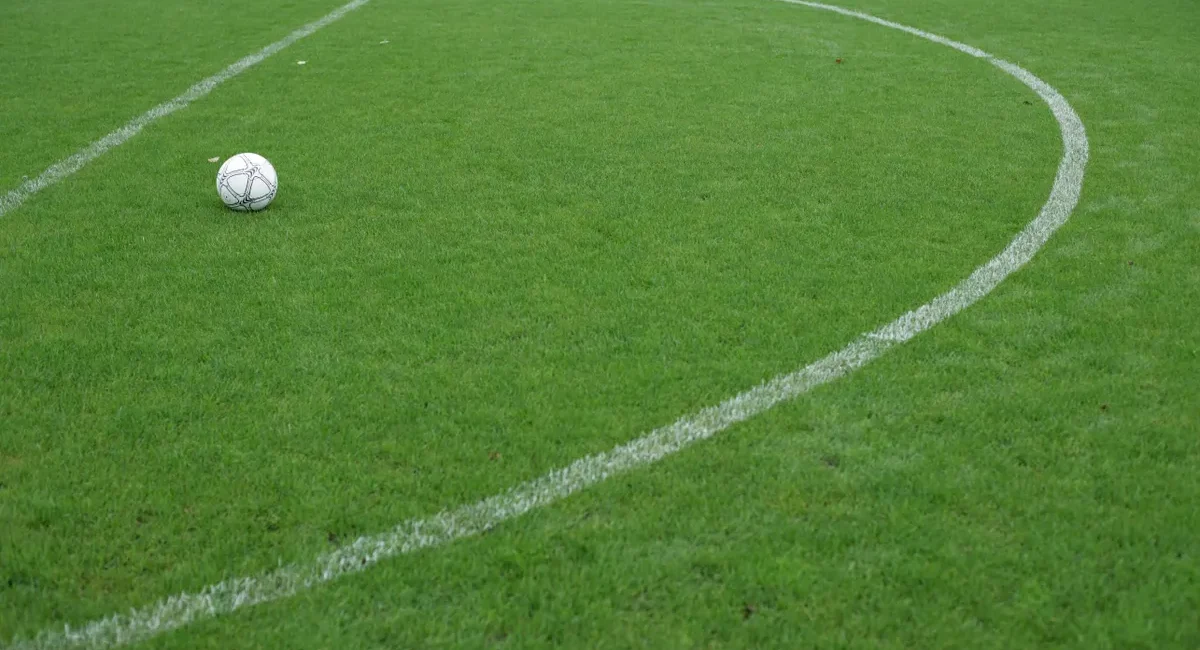
The Lajee Celtic football academy trains on a pitch surrounded by murals of resistance in Aida, a refugee camp on the outskirts of Bethlehem in the West Bank, where the nearest landmark is a military base fitted with watchtowers and security cameras. A month before this piece was written, the team spent hours clearing the pitch after an Israeli army raid, removing what 16-year-old player Majd Hameda describes as ‘around 150 teargas bombs’. The chemical residue, he says, lingers long after the canisters are gone, with substances that ‘can cause cancer’.
The club’s existence is, in almost every respect, an act of political persistence, and its story begins not on a pitch but in a stadium in Glasgow.
From Glasgow to Bethlehem: The Green Brigade Connection
In 2016, a Champions League match between Celtic and the Israeli side Hapoel Be’er Sheva became an unlikely catalyst. Before the game, the Lajee Celtic club’s parent organisation, the Lajee Centre, sent thousands of Palestinian flags to the Green Brigade, a Celtic FC ultras group known for its solidarity with the Palestinian cause. Their members raised the flags during the match. Uefa fined Celtic €10,000 for the gesture. The Green Brigade responded by launching a fundraising campaign for Palestinian charities, eventually raising over £172,000, split evenly between Medical Aid for Palestinians and the Lajee Centre.
That money was used to establish a permanent football team. Originally called Aida Celtic, it was renamed Lajee Celtic (‘lajee’ meaning ‘refugee’ in Arabic) so that it would be open to all Palestinians, and particularly refugees, not just residents of the Aida camp. The club now runs three age groups: a first team for players 18 and over, a second team for those aged 12 to 17, and a children’s team.
The Lajee Centre itself was established in 2000 by a group of young people from the camp, according to the club’s own records. It now operates with a degree of formal structure unusual for a grassroots organisation in such precarious conditions: an elected Board of Directors was introduced in 2024, formalising the club’s governance as it continues to grow.
The Lajee Celtic Football Academy and the Weight of Detention
Administrative detention, a system by which the Israeli state can imprison Palestinians without charge or trial for renewable six-month periods, has shaped the club as much as any training session. Mohammad Al-Azza, director of the Lajee Centre and one of the club’s founding members, who was shot in the face while filming from his office window in 2013, is direct about the reach of this system: ‘Anyone can get arrested. You don’t need to be part of the armed resistance. You could be arrested as a journalist, a photographer, a filmmaker, or if you take part in a protest or write a statement on social media.’
One of the team’s coaches was freed after 24 months in prison. A player on the junior team, aged 16, has been detained for the last two years. When Palestinians are granted a trial, they face the Israeli military court system, which B’Tselem, the Israeli human rights group, says carries an approximately 96 per cent conviction rate, largely based on confessions extracted under torture and duress. According to a report by Defense for Children International-Palestine, 351 Palestinian minors are currently held in Israeli prisons or detention centres, over half without charge, and those children routinely face what the organisation describes as ‘appalling and debilitating conditions’, including torture.
Samir Al-Amir, a co-ordinator at the club who helped found the Lajee Centre, was imprisoned for 19 years for his involvement in the second intifada. Released in 2022, he immediately sought a role at Lajee Celtic. Since then, he has been stopped at checkpoints approximately 50 times. ‘I have been hit very hard on many occasions,’ he says, ‘and that applies to the majority of the players.’
Those stops happen in transit to matches. When a player is pulled off the bus to be interrogated, the rest of the team waits on board, sometimes long enough to miss the game entirely. Hamada Banat, a defender on the first team who lives at a different refugee camp, puts it plainly: travelling between the divided zones of the West Bank ‘is as hard as it is to go from one prison cell to another’. His home is just over ten miles from Aida; the journey can take two and a half hours, and checkpoints close without warning, often leaving him stranded overnight.
Football as Language, Memory and Refusal
The Palestine football league has been suspended indefinitely since October 2023, limiting the club’s opportunities to compete. But the Lajee Celtic football academy continues to train, driven by what its members describe less as ambition than as necessity. Rami Masalma, a coach who previously played for the Palestine national team, frames the stakes clearly: ‘It’s important for me to show the world that as Palestinians, we are also part of the world, and like anyone else, we love to come together around this game. Despite the occupation, we still have the same passions. We can’t just be reduced to a single cause.’
For Banat, who returned to football after a four-year prison sentence, the sport is a form of reconnection as much as expression. ‘Football is an opportunity to exercise my passion, but also to deliver a message about where I am from,’ he says. Hameda, at 16, articulates something similar when he describes previous youth teams where he was never allowed to speak about his experience as a refugee: Lajee Celtic is different. ‘My father and uncles couldn’t continue with the game because they were imprisoned many times by the Israeli occupation,’ he says. ‘Football is an opportunity to exercise my passion, but also to deliver a message about where I am from and being proud as a Palestinian refugee. That’s at the core of the academy.’
Al-Azza, asked about the conditions that make training intermittent and travel dangerous, gives the answer the club effectively lives by: ‘There’s always something happening in Palestine. Maybe we can train tomorrow, maybe next month we can’t. So why not keep going?’ Lajee Celtic merchandise is available via the club’s official website.