
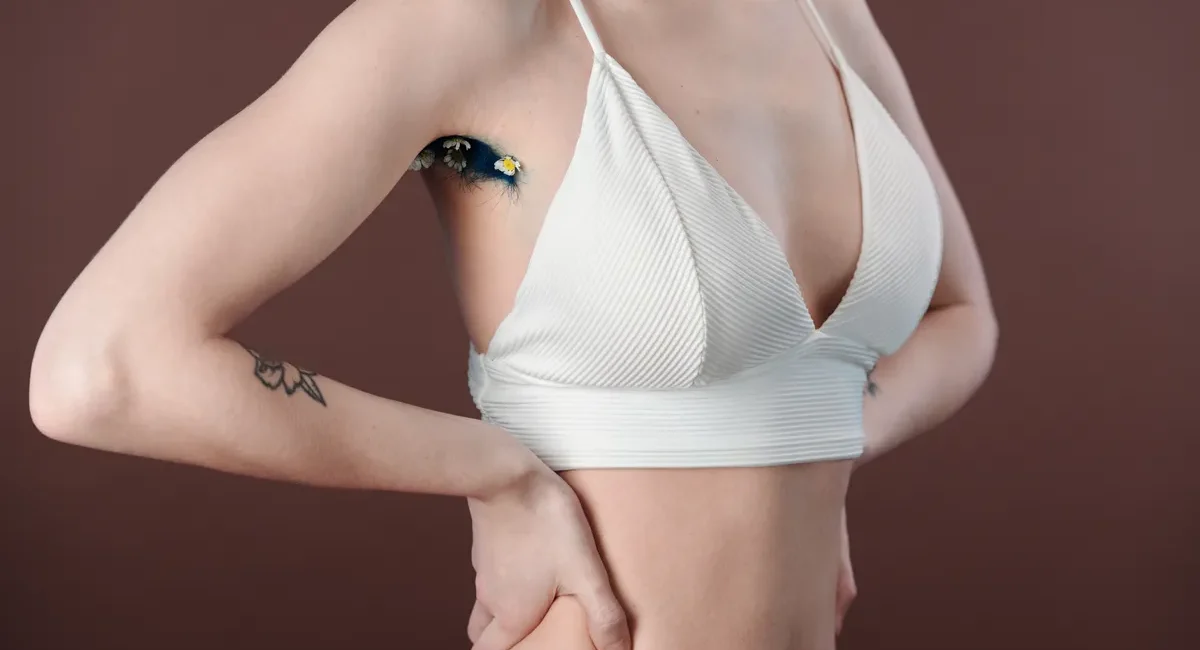
The women’s armpit hair debate has returned again this season, prompted not by any single event but by a familiar cluster of them arriving in quick succession: a Hollywood Reporter shoot, a Gucci skirt suit on the Lido, and an Instagram Story that escalated, as they tend to do, towards yeti GIFs and green vomit emojis.
The Hollywood Reporter photograph in question shows Adults actress Amita Rao with one arm raised, her underarm hair fully visible. The comments were immediate and largely predictable: ‘shave them pits jesus’, dancing razor GIFs, the usual. Rao’s response, delivered on her Instagram Story, was brisk: ‘To all the people in the comments who think this is a lot of hair, DM me and I’ll send you a pic of my bush.’
Venice, Gucci, and the women’s armpit hair debate
Rao’s moment arrived in the same week that Fashion Times reported on Phoebe Bridgers making her Venice Film Festival debut on 5 September, promoting her feature-film acting role in A24’s Primetime. The leg hair visible beneath her tailored Gucci skirt suit went viral, followed, as these things inevitably are, by a slew of articles debating whether women’s body hair is newsworthy. A self-fulfilling prophecy, as one writer put it. According to Page Six, Bridgers plays Del in Primetime, one of the decoys in the sting operation dramatised by the film, alongside Robert Pattinson, who plays Chris Hansen in the A24 production based on the rise and fall of ‘To Catch a Predator’. Then, on 7 September, Bridgers posted a candid Instagram image from the same Venice debut, grinning while an armpit sweat stain is visible on her elegant ensemble, as Yahoo Entertainment reported. The image was praised by fans. The whole sequence had the texture of a carefully observed social experiment, except no one planned it.
The reaction to Rao’s photograph echoed the response to Emily Ratajkowski’s visible underarm hair in 2019, and to Julia Roberts’s in 1999. The through-line across nearly three decades is worth sitting with: the same vocabulary of disgust, the same hygiene framings (‘Being a feminist doesn’t mean leaving your hygiene behind’), the same slightly stunned tone, as though body hair on a woman remains genuinely surprising. A YouGov poll found that over half of Brits believe women should remove their armpit hair. A 2023 US study found that 70 per cent of women shaved their armpits at least monthly, compared with just 11 per cent who never did. Among UK women surveyed, 98 per cent said they had removed body hair at some point, and 63 per cent said they actively disliked it.
The hygiene argument, in particular, does not bear scrutiny: the same logic, applied consistently, would reach 78 per cent of US men, who leave their pits alone. It rarely does.
Progress, politics, and the limits of ‘personal choice’
There was a moment, somewhere in the mid-2010s, when normalising body hair on women felt like it was gaining ground. The #FreeYourPits campaign in 2014 filled feeds with neon-pink armpits. Body positivity, at its peak, made hairy pits feel, if not mainstream, at least unremarkable in certain corners of the internet. TikTok this past year offered the spectacle of Kim K flogging merkins and influencers chanting ‘FULL BUSH IN A BIKINI!’ all summer. The discourse was meant to be settling.
The evidence suggests otherwise. If anything, body hair on women can feel more politically charged now than it did a decade ago, as beauty standards move back towards more conservative ideals. ‘It’s still politicised by others, which can be frustrating,’ says Rose*, 24. ‘I don’t think many women I know with armpit hair feel like they’re doing it as a political statement. It’s funny that I could be perceived as making a big statement when I actually just can’t be fucked to shave.’ Yasmin*, 24, finds it irritating that she’s read as ‘radical’ for declining to shave. ‘I guess [that] fuels me to keep doing it, though.’
Nina*, an artist and writer, hasn’t shaved her armpits for years, and keeps them long for precisely the filtering quality that entails. ‘Owning your hair is a really good way of filtering out those who are weird about it,’ she says. A small departure from conventional beauty standards, it turns out, can function as a reliable social litmus test.
The asymmetry between pubic hair and underarm hair matters here. The ‘full bush summer’ of online discourse stays private; the armpit does not. You can notionally embrace the former without anyone seeing whether you have one. Hairy pits require a public commitment, which means absorbing whatever reactions follow. Ali*, 27, captures the bind precisely: ‘I love seeing body hair on other women, but I’ve noticed I don’t feel comfortable growing it myself, because I feel like it matches an aesthetic I don’t have.’
Meanwhile, feminist razor brands have quietly reframed hair removal as a ‘personal choice’ and an act of self-care, folding a practice long shaped by patriarchal beauty standards and consumer culture into the language of wellness. The framing is comfortable. It is also, as the reaction to Rao’s Hollywood Reporter photograph makes clear, somewhat beside the point. More than a decade after #FreeYourPits tried to shift the conversation, armpit hair on women is still treated as a statement, whether the person growing it intends one or not.
The YouGov poll did find that women aged 16 to 24 were the most likely group to have no preference about whether women remove their armpit hair, while those aged 40 and above were the most likely to think it should be removed. Generational change, then, is plausibly in motion. It just has not yet reached the comments section.